Our History

Mrs. C.B. (May Belle Hitchcock) McGarity founded The Dallas Woman’s Club in 1920 with the aim of serving the community and creating a better society. Mrs. McGarity was the first woman in Paulding County to register to vote. She was appointed a member of the Seventh Congressional District Democratic Executive Committee for 1922-1924. She was Paulding County’s first woman Delegate to the Georgia Democratic Convention, 1924. For her active role in community affairs, Mrs. McGarity was named “Citizen of the Year” for Paulding County in 1977. Today, there is an elementary school named after our President.

Our club was officially organized on July 12, 1920. “The object of the club was in the intellectual and moral development of the members and aiding in the work of improving our town and school.” The immediate work of the club was to build a community house. A year later, the Dallas Woman’s Club members hosted an open house on July 4, 1921, which saw a record attendance of 408 women visiting the clubhouse. The first meeting held in the clubhouse was on July 11, 1921. Since then, our clubhouse has been an integral part of our community. In the early years it was used as a public women’s restroom, a library, and a community house, and hosted numerous events and meetings over the years. We look forward to continuing our traditions and making new memories in this historic venue.
The Dallas Woman’s Club was the first community library in Dallas from 1921 to 1979.
The Dallas Woman’s Club was also instrumental in the creation of the Paulding Meadows Festival. In 1979, an idea was conceived to establish a festival that would provide local crafters with a platform to showcase and sell their handmade items. Our club was one of the eleven founding organizations that helped bring this idea to life. Today, the Paulding Meadows Festival has grown to host over 300 vendors, crafters, and artisans with an attendance of over 50,000 visitors. We are proud to say that all proceeds from the festival go towards supporting local charities and organizations in our community.
Please visit our 1921 Project Page for historical information on our Clubhouse.
Notable Monuments – Building
- Dallas Woman’s Clubhouse
- Elizabeth McKoon Memorial Park (Past President of Dallas Woman’s Club)
- McGarity Elementary School, named after Past President’s family.
Historical News Articles:
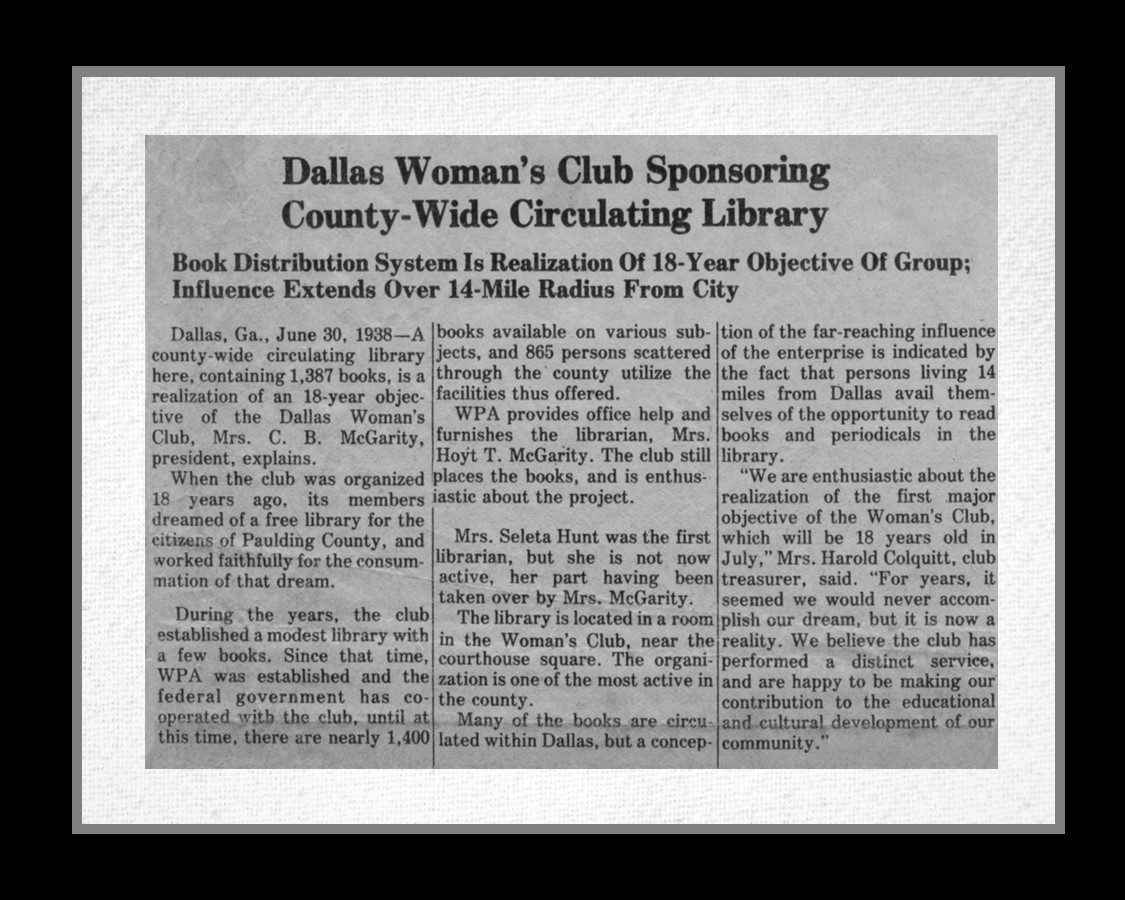
Paulding Library Services Comes to Life
Dallas Woman’s Club, Episode 4 – Paulding County Genealogical Society Video

The history of our international organization, the General Federation of Women’s Club began in 1890, but our GFWC’s roots can be traced back to 1868 when Jane Cunningham Croly, a professional journalist, attempted to attend a dinner at an all-male press club honoring British novelist Charles Dickens. Croly was denied admittance based upon her gender, and in response, formed a woman’s club—Sorosis. In celebration of Sorosis’ 21st anniversary in 1889, Jane Croly invited women’s clubs throughout the United States to pursue the cause of federation by attending a convention in New York City. On April 24, 1890, 63 clubs officially formed the General Federation of Women’s Clubs by ratifying the GFWC constitution.
In 1895 GFWC travelled to Atlanta, Georgia to talk with the women in Georgia at the Cotton States Exhibition held at Piedmont Park. Our founder, Rebecca Douglas Lowe attended the GFWC presentation and was inspired to begin a woman’s Club in Atlanta. In 1895 she founded The Atlanta Woman’s Club. After the formation of The Atlanta Woman’s Club, Mrs. Lowe realized the need to create a State organization known as the Georgia Federation of Women’s Club (GFWC Georgia) so that all local clubs throughout the State of Georgia could call upon for resources and guidance. Mrs. Lowe was its First President in 1896 and went on to be GFWC’s third President.
Today, our International organization has over 80,000 members in affiliated clubs in every state, the District of Columbia, and more than a dozen countries. Our State organization, GFWC Georgia has approximately 90 clubs within the State of Georgia with approximately 2,400 members.
By Living the Volunteer Spirit, GFWC clubwomen transform lives each day, not simply with monetary donations, but with hands-on tangible projects that provide immediate impact. With a grassroots approach that often thinks locally but impacts globally, GFWC, its clubs and members remain committed to serving as a force for global good, as it has done since its formation over 125 years ago.